

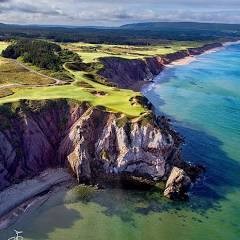
Cabot Cape Breton, the CBC and the Mad Professor. What a little more research may reveal
I was interviewed last week by CBC reporter Tom Ayers prior to Premier Houston’s decision to kibosh a contested proposal to build a new golf course in West Mabou Beach Provincial Park, Cape Breton. Basically, I took apart the flimsy reasoning being used to convince citizens that converting beautiful public lands to private development was the best option. After Houston’s unexpected change of heart, Tom Ayers contacted me to say CBC was still going to run the interview “though, focused on the economic benefit claims from Cabot so far. That story is still relevant,” he said.
One claim I made in an opinion piece, which triggered the interview, was that the three world-class golf courses owned by Cabot Cape Breton in Inverness (7 PIDs in total according to Property Online) were assessed at only $7,803,400 (actually, $7,707,100) which carried a total commercial property tax bill of $146,542 (actually, $147,205).
Ayers told me that Property Online lists 37 properties under Cabot Cape Breton, and that my numbers were limited to the actual green fields where the golf courses are located. To this I could only scratch my head – my focus was always on the assessed value and corresponding property taxes of their fabulous golf courses or “green fields” as Ayers calls them.
“Cabot”, as Ayers noted in an email, “has a lot of other commercial and residential properties connected to or next to golf courses.” Further to delivering obvious points, the good reporter failed to get to the bottom of the story. His main source was Keith MacDonald, Inverness county's chief administrative officer, who said Cabot's tax bill in 2025? was just over $1.2 million, which included $630,573 in commercial taxes and $592,871 in residential taxes.
A headline was posted on the CBC website: “Cabot golf properties contribute $1.2M in taxes to Inverness County. Critic says golf course lands generate little tax, but county records show overall benefit.”
The CBC report also added my point that “since the Cabot Links course opened in 2012, Inverness County's population has barely increased, and the average annual income has remained below provincial and national averages.” This is true, but CBC failed to reveal my source for this point which was made clear in my opinion piece – Statistics Canada.
Without an attribution, I come across as a flailing lunatic who’s blowing smoke out of my hat. Again, a link to my article would’ve offered clarity – a point underscored by a number of people who contacted me to say how CBC missed the mark on the story and that linking it to the original article would’ve only been responsible.
So, What is the story?
Property Online is a Government of Nova Scotia service that for a fee provides access to landownership and related information connected through Land Registry and other resources. There is a detailed breakdown, including ownership, size, classification of property (commercial, residential or resource) and corresponding taxable value.
So, what information can you get on Cabot Cape Breton? First, there are 37 properties listed under Cabot CB in 2025. Twenty-eight properties are listed as commercial (five of which are part resource) with a total value of $16,668,400. In Inverness the commercial tax rate is 1.91 which means that Cabot paid or will pay $318,366 in commercial property taxes in 2025.
Four properties are listed as residential and of these three consist only of land. The total value is $1,228,700. The residential tax rate in Inverness is 1.05 which means that Cabot paid or will pay $12,901 in residential properties taxes in 2025.
Nine of the 37 properties are listed as resource or partly resource. The total value is $206,600. In Inverness the resource tax rate is 1.05 which means that Cabot paid or will pay $2,169 in resource property taxes in 2025.
So, the total value of all 37 properties under Cabot Cape Breton on Property Online in 2025 is $18,103,700, and the total property taxes paid in Inverness County by Cabot in 2025, using the calculations above is (or will be) $333,436 (give or take a small amount).
I did check with the Property Valuation Services Corporation (PVSC) and they did a calculation and get around $20,000,000 for total assessed value of all Cabot Cape Breton properties in 2025. PVSC didn’t tell me yet how they arrived at their number – maybe an assessment was changed, but the corresponding property taxes would vary by no more than ten percent.
In any event, both numbers are three to four times less than the $1.2 million that Keith MacDonald claims Cabot contributed.
I suspect that the number $592,871 in residential taxes is derived from the condos that were sold by Cabot to private individuals, which are also available on Property Online. But Cabot didn’t pay the residential property tax, the owners did, which explains why Property Online doesn’t list them under Cabot Cape Breton, and rightly so.
As for the claim that Cabot paid $630,573 in commercial property tax, that’s beyond me. Maybe Cabot, MacDonald or Ayers can provide an answer. Property Online and the PVSC don’t.
Those who read my opinion piece in the Cape Breton Post or other news sites, may recall that the taxpayers of Nova Scotia have given Cabot a lot more in loans and subsidies than the annual $333,436 to cover the property tax. Already back in 2018 it was estimated to be $17 million, but that number, as I noted before, may be just scratching the surface.
In fact, Cabot just received another $2 million.
There is also the question of a $25 million low interest loan that was given to Cabot, which was also mentioned in my opinion piece. If so, even a saving of two percentage points would be far more than Cabot is contributing in all forms of property tax according to Property Online. The government can confirm or deny it. Maybe Tom Ayers can pursue this story angle, and others related to subsidies and loans given to Cabot, rather than pointing out that the company has 37 properties rather than seven, and then moving on to another story.
Gerard Naddaf is emeritus professor of philosophy, York University, Toronto. Formally from North Sydney, he now divides his time between Halifax and Cape Breton. His most recent book is Making Sense of Myth. Conversations with Luc Brisson, McGill-Queen’s University Press, 2024.



0
Log In or Sign Up to add a comment.- 1
arrow-eseek-eNo items to display